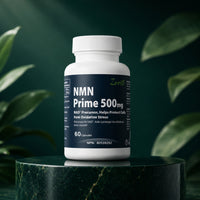

The Difference You Cannot See
Place two NMN capsules next to each other and they look identical. White powder. Simple capsule. Promises like “99% pure” “maximum potency” and “anti-aging support” printed on the label.
In reality, one capsule could support healthy NAD+ levels while the other could be nothing more than filler or, worse, contaminated powder.
As NMN supplements surge in popularity and longevity research gains mainstream attention, the market has become crowded with low-quality and misleading products. Demand is high. Raw materials are expensive. That combination attracts shortcuts and bad actors.
The result is a supplement space where labels cannot be trusted and price means very little unless it is backed by proof. That proof comes from one document: the Certificate of Analysis, also known as a COA.
This guide explains why NMN purity matters, how third-party testing protects you, how to read a COA, and how to avoid fake or ineffective NMN supplements.
Why the NMN Supplement Market Is Risky
Dietary supplements are regulated very differently from prescription drugs. In the United States, supplement companies do not need FDA approval before selling a product. Testing often happens only after problems are reported.
That means a brand can sell NMN without proving that the product actually contains NMN.
Independent testing has revealed how serious this issue is. In a widely cited analysis of top-selling NMN supplements sold online, researchers found that:
-
Some products contained zeroo NMN
-
Most contained less than one percent of the claimed amount
-
Only a small fraction met label claims
Buying NMN based on reviews or packaging alone gives you a high chance of wasting money or taking something unsafe.
Why NMN Purity Is About More Than Price
Low-quality NMN does more than empty your wallet. It can make your entire supplementation plan ineffective or even harmful.
Effectiveness Depends on Dose Accuracy
NMN supports NAD+ production, which plays a key role in cellular energy, metabolism, and DNA repair. These pathways depend on reaching specific dosage levels.
If your supplement is diluted with fillers or underdosed, you may get no benefit at all.
Impurities Can Accumulate Over Time
NMN is synthesized in laboratories, and poor manufacturing can leave behind solvents, heavy metals, or unknown byproducts. When taken daily, even small contaminants can build up in the body.
This makes heavy metal testing essential for any NMN supplement.
Degraded NMN Can Work Against You
NMN is sensitive to heat and moisture. When it degrades, it turns into nicotinamide. At high levels, nicotinamide can interfere with sirtuin activity, which is one of the main reasons people take NMN in the first place.
Purity without stability is not enough.
What Third-Party Testing Really Means
Many brands say “lab tested” but that phrase often means nothing.
True third-party testing means the finished product is sent to an independent laboratory with no financial connection to the brand. The lab verifies identity, purity, potency, and safety, then issues a Certificate of Analysis.

Why ISO 17025 Matters
The most reliable labs are ISO 17025 accredited. This international standard confirms that the lab follows validated testing methods, uses calibrated equipment, and employs qualified analysts.
If a brand claims third-party testing but does not share the COA or uses an unknown lab, that is a clear warning sign.
How to Read a Certificate of Analysis for NMN
A COA may look technical, but you only need to check a few key sections.
Step 1: Verify the Basics
Check the lab name and confirm it is reputable. Look at the test date and make sure it is recent. Most importantly, match the lot number on the COA with the lot number on your bottle.
If the lot numbers do not match, the report does not apply to your product.
Step 2: Confirm NMN Potency
Look for HPLC testing, which is the gold standard for measuring NMN purity.
The results should clearly list beta-NMN content as a percentage or milligrams per serving. A 500 mg capsule should test close to that amount. High-quality NMN typically tests at 99 percent purity or higher.
Step 3: Review Heavy Metal Results
Check for arsenic, cadmium, lead, and mercury. Results should read “not detected” or show extremely low levels measured in parts per million.
Elevated lead levels are especially concerning for daily supplements.
Step 4: Check Microbial Safety
The COA should show negative results for E. coli, salmonella, yeast, and mold. Anything else is unacceptable.
Common Red Flags to Avoid
Proprietary Blends
If NMN is listed inside a blend without an exact dose, avoid it. This often hides tiny amounts of NMN mixed with cheap fillers.
Unrealistically Low Prices
High-quality NMN is expensive to produce. If the price is far below the market average, quality is almost always compromised.
No Real Company Information
Brands without a physical address or phone number often disappear quickly after selling poor-quality batches.
Purity Claims Without Proof
“99% pure” printed on a label means nothing without a matching third-party COA.
Stability and Packaging Matter Too
Even pure NMN can degrade if stored or shipped improperly.
Signs of a quality-focused brand include:
-
Amber or opaque bottles
-
Moisture-absorbing desiccant packets
-
Attention to temperature during shipping
-
Use of stabilized NMN forms
These details protect potency from the factory to your cabinet.
Final Thoughts: Transparency Is the Real Supplement
NMN and NAD+ research shows real promise for metabolic health and healthy aging. But those benefits only come from products that are pure, tested, and stable.
The best NMN supplement is not the one with the loudest marketing. It is the one that proves what is inside the bottle.
Take a moment to check your current NMN. Find the lot number. Look for the Certificate of Analysis. If you cannot access it or the brand will not provide it, that tells you everything you need to know.
Your health deserves evidence, not promises. That's why Zeroo is here.
References
-
Quantitative Analysis of Twenty-Two NMN Consumer Products (ChromaDex): https://s23.q4cdn.com/937095816/files/doc_downloads/2021/Quantitative-Analysis-of-22-NMN-Consumer-Products-Oct-2021.pdf
-
Testing the amount of nicotinamide mononucleotide and urolithin A as compared to the label claim (NIH): https://pmc.ncbi.nlm.nih.gov/articles/PMC11335992/
-
FDA Advisory on Unregistered NMN Supplements: https://www.fda.gov.ph/fda-advisory-no-2024-0216-public-health-warning-against-the-purchase-and-consumption-of-the-unregistered-food-supplement-california-gold-nutrition-nmn-nicotinamide-mononucleotide-300mg-dietary-su/
-
FDA Reinstates NMN As Dietary Supplement After NPA Lawsuit: https://www.npanational.org/news/fda-reinstates-nmn-as-dietary-supplement-after-npa-lawsuit/
-
Nicotinamide Mononucleotide Supplementation: Metabolic Variability and Clinical Implications: https://pmc.ncbi.nlm.nih.gov/articles/PMC11205942/
-
The efficacy and safety of β-nicotinamide mononucleotide (NMN) supplementation in healthy middle-aged adults: https://pubmed.ncbi.nlm.nih.gov/36482258/
-
How to choose an NMN supplement (Elysium Health): https://www.elysiumhealth.com/blogs/aging101/how-to-choose-an-nmn-supplement
-
How to Read Supplement Labels Like a Pro (Healthline): https://www.healthline.com/nutrition/how-to-read-supplement-labels
-
NR, NMN, & NAD+ Supplements: What Testing Reveals About Quality: https://www.aboutnad.com/blogs/blog/nr-nmn-nad-supplements-what-testing-reveals-about-quality