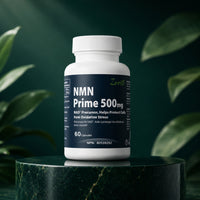

The quest for healthy aging is as old as time. In recent years, the conversation has shifted from simply adding years to life, to adding life to years. And in this conversation, one molecule is creating a buzz so loud it’s almost impossible to ignore: NMN.
You may have seen it mentioned by scientists on podcasts, promoted by biohackers, or discussed in forums dedicated to longevity. The central claim is powerful: that NMN can help reverse aspects of aging at a cellular level.
But what is it, really? Does it work? And, most importantly for residents here, what is the status of NMN in Canada?
This guide will cut through the hype to give you a simple, fact-based look at NMN. We'll explore the science, what the research actually says, and the specific rules and regulations that matter to Canadians.
Part 1: The "Why" — Your Body's Most Important Molecule
Before we can understand NMN, we have to talk about the molecule it serves: NAD+.
NAD+ (which stands for nicotinamide adenine dinucleotide) is not some obscure chemical. It is a coenzyme found in every single cell of your body. Think of it as the CEO of your cellular operations. It’s essential for two main jobs:
-
Energy Production: NAD+ is crucial for metabolism. It helps turn the food you eat (like glucose) into the energy your cells use to function. Without NAD+, your cellular "power plants" (the mitochondria) shut down.
-
Cellular Repair and Maintenance: This is where the aging-related buzz comes from. NAD+ acts as the fuel for a special group of proteins called sirtuins. You can think of sirtuins as your body's emergency response team. They repair damaged DNA, reduce inflammation, and protect your cells from stress.
Here’s the problem: Your NAD+ levels naturally decline as you age.
By the time you reach middle age, your NAD+ levels may be 50% less than what they were in your youth. As NAD+ levels fall, that cellular "CEO" is less effective. The power plants get sluggish, and the repair team can't keep up with the damage. This decline is considered one of the key hallmarks of aging.
This leads to an obvious question: If low NAD+ is a problem, can't we just... get more?
Part 2: The "What" — What is NMN?
You can't just take an NAD+ pill. The molecule is too large to be absorbed directly into your cells. Instead, you need to give your body the raw materials, or "precursors," it uses to make its own NAD+.
This is where NMN (Nicotinamide Mononucleotide) comes in.
NMN is a molecule that is one simple step away from becoming NAD+. Your body has a natural pathway that converts NMN directly into NAD+.
-
Simple Analogy: Imagine your cell is a factory that needs a finished product (NAD+). NMN is like a fully-assembled kit that just needs to be unboxed and put on the shelf.
Your body does get NMN from food, but in tiny amounts. You can find it in things like broccoli, cabbage, cucumbers, and avocados. However, the quantities are so small that you would need to eat an impractical amount to significantly boost your NAD+ levels, which is why people have turned to NMN supplements.
Part 3: The Big Question: Is NMN Legal in Canada?
This is the most important—and often most confusing—question for Canadians. The internet is full of mixed information, much of it from the United States.
Here is the clear, simple answer: Yes, NMN can be legally sold in Canada, but it MUST be licensed by Health Canada.
Unlike in the U.S., where NMN is typically sold as a "dietary supplement," in Canada, such products fall under the Natural Health Product (NHP) regulations. This is a good thing for consumers, as it means products must be reviewed for safety and health claims before they can be sold.
How to Tell if an NMN Product is Legal in Canada
To be legally sold in Canada, an NHP must have a product licence. When a product is licensed, Health Canada assigns it an eight-digit Natural Product Number (NPN).
This NPN must be printed on the product's label.
This is your single most important checklist item:
-
Look for an NPN on the label.
-
If it has an NPN, Health Canada has reviewed it.
-
If it does not have an NPN, it is not legally licensed for sale in Canada.
You can verify any NPN by searching the official Health Canada Licensed Natural Health Products Database online. This database will tell you the company, the ingredients, and the approved health claims.
For example, a search of this database shows that products containing NMN have been licensed and are listed as "marketed" in Canada, confirming their legal status when they go through the proper channels.
Why Is There So Much Confusion? (The U.S. Situation)
Much of the confusion online comes from a situation in the United States. In late 2022, the U.S. Food and Drug Administration (FDA) announced that NMN could no longer be marketed as a dietary supplement because it was being investigated as a potential new drug. This caused panic and led to many major online retailers pulling NMN from their virtual shelves.
Crucial Update (October 2025): In a major reversal, the FDA has just confirmed (as of late September 2025) that NMN is, in fact, lawful for use in dietary supplements. This very recent news is causing NMN to return to U.S. stores, but the years of uncertainty created a lot of confusion that spilled over into Canada.
The key takeaway for Canadians is simple: Ignore the U.S. drama. Our system is different. Just look for the NPN.
Part 4: The Hype vs. The Science: What Can NMN Really Do?
This is where we need to be very careful. Most of the extraordinary claims about NMN—like reversing aging and extending lifespan—come from studies on mice. While promising, mice are not people.
However, human studies are now being published, and they are giving us a clearer picture.
What the Human Evidence Shows
-
It Definitely Boosts NAD+: This is the most consistent finding. A key 2023 human trial in Geroscience confirmed that taking NMN supplements (in doses from 300 mg to 900 mg) significantly increases whole-blood NAD+ levels. The raw material gets in and does its first job.
-
May Improve Insulin Sensitivity: This is one of the most significant findings. A landmark 2021 study published in the journal Science found that NMN improved muscle insulin sensitivity and insulin signaling in prediabetic, postmenopausal women. This is a crucial marker for metabolic health.
-
May Improve Physical Performance: A 2021 study on amateur runners, published in the Journal of the International Society of Sports Nutrition, found that NMN combined with exercise improved their aerobic capacity (how well the body uses oxygen) more than exercise alone. The study suggested this was due to enhanced oxygen utilization in skeletal muscle.
What's Still Unclear or Just Hype
-
Lifespan: There is no human evidence that NMN makes people live longer.
-
Cognition: While NMN restoring cognition in old mice makes for a great headline, this has not been replicated in human cognitive studies.
-
Muscle Strength: The data here is mixed. This is a very active area of research. For example, a 2025 meta-analysis (a study of other studies) concluded NMN showed positive effects on muscle function and gait speed. However, another 2025 meta-analysis from a leading journal found that, based on current evidence, NMN did not significantly preserve muscle mass or function in older adults. This shows that the science is still evolving and more research is needed.
In short, the human science is young but promising. It suggests NMN's benefits are less about "reverse aging" and more about supporting cellular energy and function as you age, particularly in areas of physical performance and metabolic health.
Part 5: NMN vs. NR: Which "NAD+ Booster" is Better?
You will almost certainly see another molecule for sale right next to NMN: NR (Nicotinamide Riboside).
NR is NMN's main competitor. It is also an NAD+ precursor and, for a long time, was the more popular and well-studied of the two.
So, what's the difference?
-
The Pathway: NR is actually one step before NMN. The body converts NR into NMN, and then that NMN is converted into NAD+. (The path is: NR → NMN → NAD+).
-
The Debate: For years, the argument for NR was that NMN was too large a molecule to get into cells directly and had to be converted into NR first just to get inside. However, this theory was challenged by the discovery of a specific "NMN transporter" that allows NMN to be absorbed directly in the gut.
-
The Science: NR has been on the market longer and has more human studies, which confirm it is safe and effective at boosting NAD+. NMN has more exciting animal studies, and its human trials are just now catching up.
The Verdict: There is no clear winner. No major head-to-head human trial has proven one to be better than the other. Both are effective at raising NAD+ levels.
Part 6: Safety, Side Effects, and Dosage
Based on the human studies available, NMN appears to be very safe and well-tolerated.
-
Safety: Studies using doses as high as 1,200 mg per day for six weeks have not reported any serious side effects.
-
Side Effects: The most commonly reported side effects are minor, such as mild stomach upset or headache, but these are not common.
-
Dosage: Most human studies use daily doses in the range of 250 mg to 900 mg.
-
Who Should Not Take It: The safety of NMN has not been studied in pregnant or breastfeeding women. Therefore, it should be avoided by these groups. As with any supplement, it is wise to speak with your doctor before starting.
For athletes, it's worth noting that NMN is not on the 2025 World Anti-Doping Agency (WADA) Prohibited List.
Part 7: Beyond the Pill: Natural Ways to Boost NAD+
You don't have to rely on a supplement to protect your NAD+ levels. Lifestyle choices play a massive role.
-
Exercise: This is the most proven natural NAD+ booster. Both aerobic (running, cycling) and resistance (weightlifting) exercise stimulate the production of enzymes that create NAD+.
-
Fasting / Time-Restricted Eating: When your body is in a fasted state, it activates sirtuins for repair, which in turn boosts NAD+ levels. Even a simple 16:8 eating window (eating all your food in an 8-hour period) can help.
-
Eat B3-Rich Foods: Your body can also make NAD+ from Vitamin B3 (niacin). You can find it in foods like turkey, chicken, salmon, tuna, whole grains, and legumes.
-
Get Good Sleep: NAD+ production is tied to your circadian rhythm. Poor sleep disrupts this rhythm and can deplete NAD+ levels.
Part 8: Further Reading & Journal Resources
For those who want to review the science themselves, here are links to the key human studies mentioned in this article.
-
The Landmark Insulin Sensitivity Study (2021)
-
Title: Nicotinamide mononucleotide increases muscle insulin sensitivity in prediabetic postmenopausal women.
-
Journal: Science
-
What it found: NMN supplementation improved muscle insulin sensitivity and insulin signaling in this specific group.
-
The General Efficacy and Safety Trial (2023)
-
Title: The efficacy and safety of β-nicotinamide mononucleotide (NMN) supplementation in healthy middle-aged adults: a randomized... trial.
-
Journal: Geroscience
-
What it found: NMN effectively increased whole-blood NAD+ levels and improved physical performance (measured by a 6-minute walk test) in healthy adults.
-
The Physical Performance (Runner) Study (2021)
-
Title: Nicotinamide mononucleotide supplementation enhances aerobic capacity in amateur runners: a randomized, double-blind study.
-
Journal: Journal of the International Society of Sports Nutrition
-
What it found: NMN, when combined with exercise, improved the aerobic capacity of runners by enhancing the oxygen utilization capacity of skeletal muscle.
-
Systematic Review on Muscle Function (2025)
-
Title: The Effect of Nicotinamide Mononucleotide and Riboside on Skeletal Muscle Mass and Function: A Systematic Review and Meta-Analysis.
-
Journal: Journal of Cachexia, Sarcopenia and Muscle
-
What it found: This review concluded that current evidence does not support NMN supplementation for preserving muscle mass or function in older adults. This highlights the need for more research.
-
General Review on NAD+ Precursors
-
Title: Therapeutic Potential of NAD + Precursors and Aging-related Diseases
-
Journal: International Journal of Biomedical Science
-
What it found: A good overview of the science behind NAD+ precursors (both NMN and NR) and their potential for age-related conditions.
-
Link: https://www.ijbs.org/user/ContentFullText.aspx?VolumeNO=18&StartPage=35
Conclusion: A Realistic Guide for Canadians
NMN is one of the most exciting molecules in longevity science. It is not a magic "anti-aging" pill, but it is a supplement with emerging human evidence supporting its role in boosting NAD+, a vital resource for cellular energy and health.
For Canadians, the path is clear:
-
It is Legal: NMN is legally sold in Canada as a Natural Health Product.
-
Be a Smart Shopper: Your only guarantee of a legal, licensed product is to look for the NPN on the label.
-
Know the Facts: The evidence points to benefits in physical performance and metabolic health, but the more dramatic claims are still unproven in humans, and some areas (like muscle strength) have conflicting data.
-
Think Holistically: You can support your NAD+ levels for free through exercise, smart eating, and good sleep.
NMN is a promising tool, but it's just one part of a larger healthy aging puzzle. If you are considering it, look for that NPN, talk to your healthcare provider, and see if it's the right choice for you.